Multi-cloud management, one operating model.
Keep AWS, GCP, Azure, OCI, and Kubernetes under the same live-risk, policy, cost, fix, and reporting model.
ops0 brings your clouds, runtime, infrastructure code, and workflows into one operating context. Multi-cloud management keeps AWS, GCP, Azure, OCI, and Kubernetes under one discovery, policy, cost, and reporting model instead of separate provider-by-provider workflows.
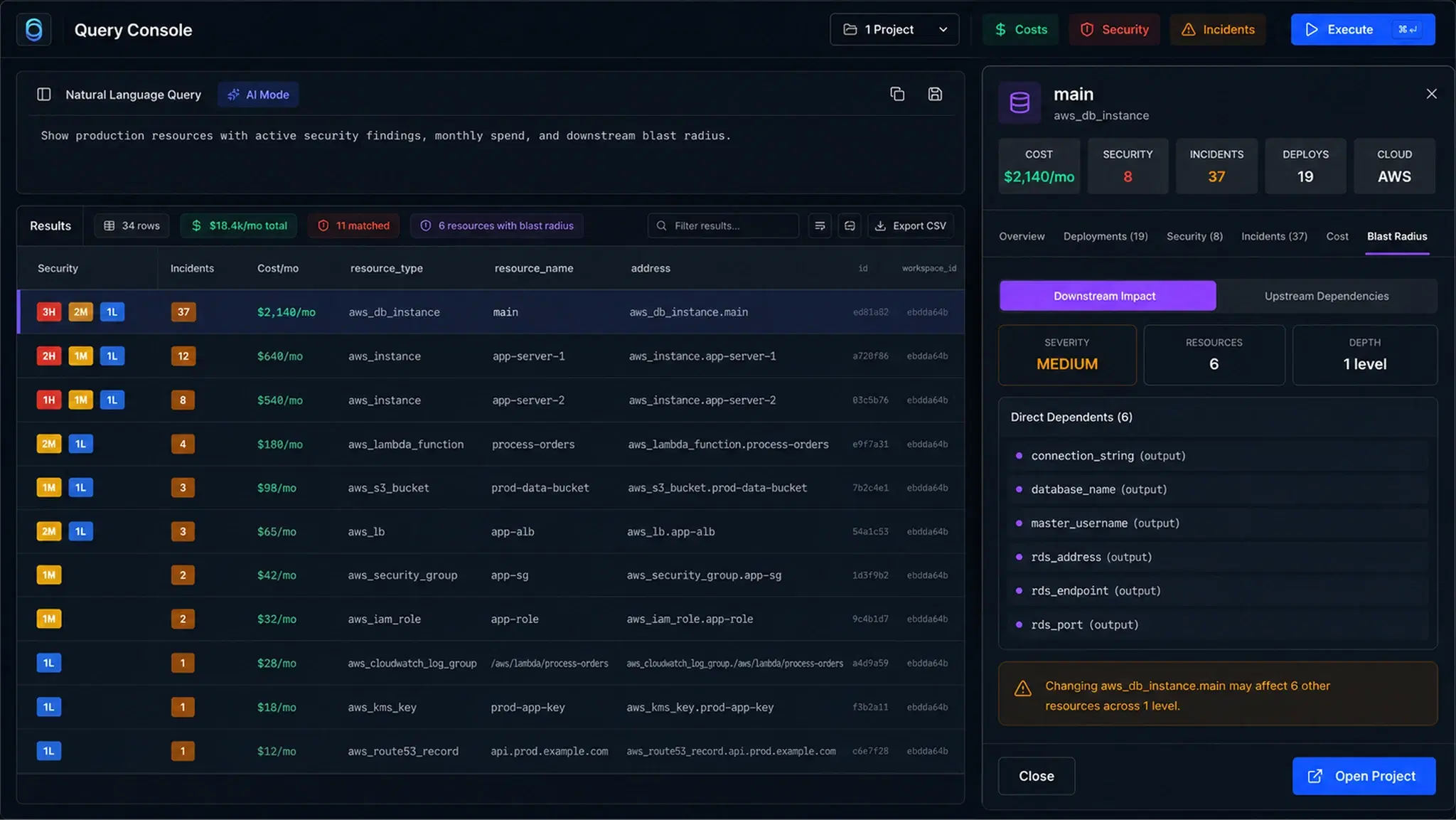
Four clouds usually means four ways of working. ops0 gives them one.
Four consoles, four answers.
Each cloud has its own inventory, its own policies, its own reports.
One model, not four.
One inventory across providers.
One model, every layer.





Runs any compatible Terraform or OpenTofu provider through the same plan, policy, and approval path as AWS, GCP, Azure, and OCI.
- EKS
- GKE
- AKS
- OKE
- Self-managed
From live state, not a blank file.
In practice
Review AWS and GCP together, keeping provider boundaries clear.
Illustrative workflow: an application has resources in an AWS account and a GCP project. Start with read-only inventory, reconcile ownership and dependencies, then review a planned change in the provider and project that own it.
Connect and reconcile each scope
Review read-only access for the AWS account and GCP project separately. Compare discovered resources with the provider consoles and record any permission or region gaps.
Normalize ownership and environment
Review AWS tags and GCP labels with the owning teams. Keep provider, account or project, region, and resource identifier attached to every resource.
Verify dependencies
Use configuration and provider evidence to establish what a proposed change affects. A matching tag or shared application name does not prove a network connection between clouds.
Review the plan within its boundary
Identify the owning IaC project, state, credentials, policy checks, and approver. Review each provider’s changes and any sequencing requirements before applying through the approved path.
Unified visibility helps teams coordinate decisions. AWS and GCP retain separate identity, networking, state, and deployment boundaries. Confirm those boundaries when evaluating impact.
Common questions
More clouds should not mean
more operating models.
ops0 keeps discovery, policy, cost, deployment, and reporting consistent as the estate spreads across providers.