Deployment
Pipeline
Deploy infrastructure with confidence. Multi-stage pipelines with approval gates and cost enforcement.
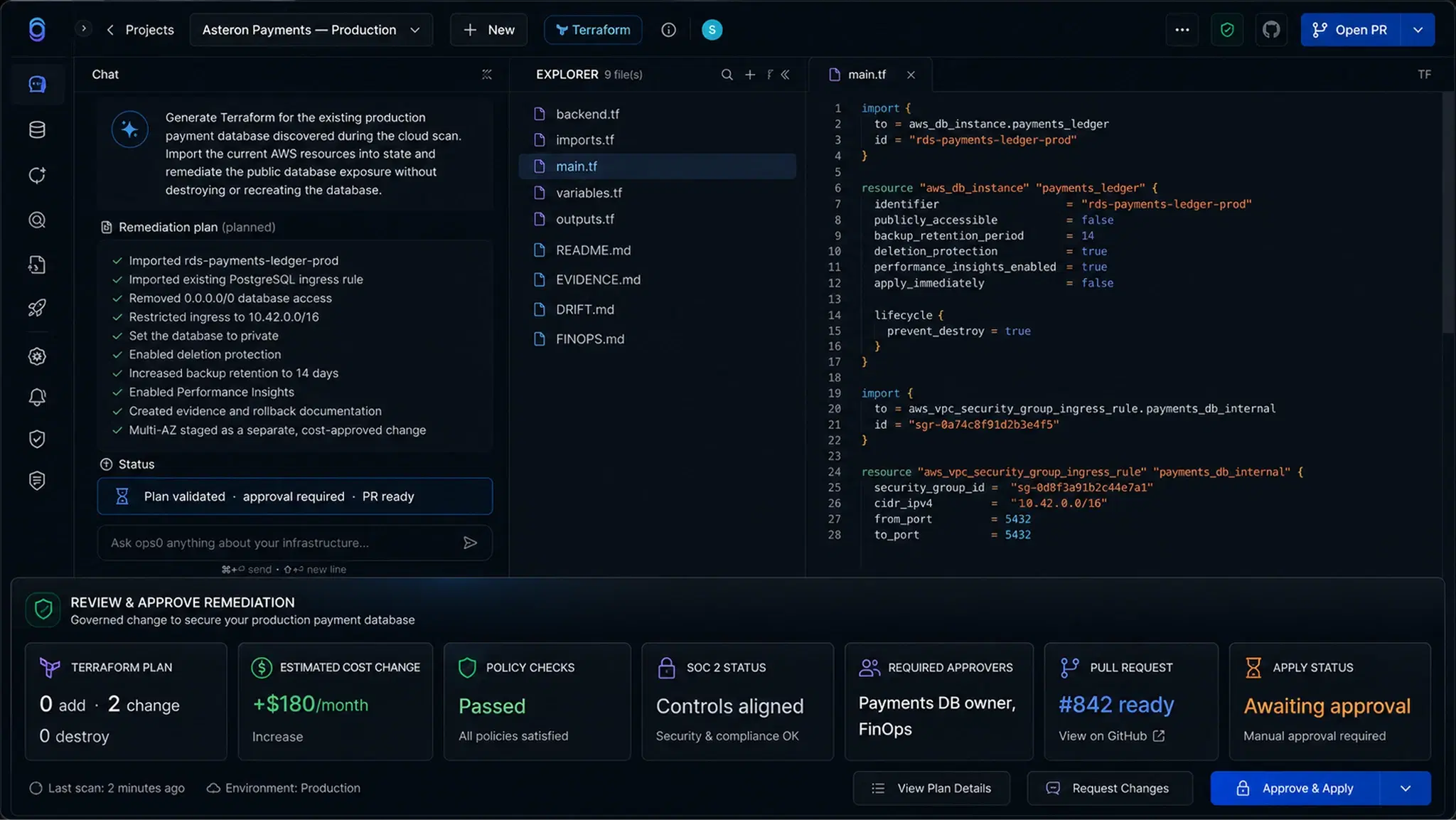
Deployment is where infrastructure decisions become reality. ops0 gives every change a deliberate path through planning, policy enforcement, cost review, and human approval before a single resource is created or modified.
Five Stages Between Intent and Reality
Unreviewed infrastructure changes cause incidents. Every deployment flows through Plan, Policy Check, Cost Estimation, Approval Gate, and Apply, in that order. The plan shows exactly what will change. Policy checks block violations before they ship. Cost estimation shows the monthly impact down to the resource level. The approval gate requires a human to sign off. Only then does Apply run. Nothing skips the line.
Cost Enforcement Before You Commit
Expensive surprises appear on cloud bills because nobody checked the cost before deploying. ops0 shows you the cost impact of every deployment automatically, with per-resource breakdowns. Budget enforcement policies stop deployments that would exceed your configured limits. The rejection includes a clear explanation, so teams understand why they were blocked and can right-size before re-submitting.
Drift Detection Keeps Code and Reality Aligned
Someone always makes a quick change in the console. Drift detection identifies when your running infrastructure diverges from what your Terraform state describes. Drift shows up clearly in the deployment interface, and you can choose to reconcile it or update your code to match what is actually running. Scheduled scans run on a cadence you control so drift does not accumulate silently.
GitOps: Git Is Your Audit Trail
Infrastructure changes should be as traceable as code changes. Pull requests automatically trigger deployment plans, showing reviewers exactly what will happen. Merge to main to execute. Every deployment links back to a commit, a pull request, and the person who approved it. GitHub and GitLab are both supported, so you work with whatever your team already uses.
State Backends Across Every Cloud
Terraform state is as sensitive as production data, and it needs a reliable home. ops0 supports S3 for AWS teams, GCS for Google Cloud, Azure Blob Storage for Microsoft environments, and OCI Object Storage for Oracle Cloud. State locking is configured automatically to prevent concurrent modifications, and state files are encrypted at rest and in transit.
Kubernetes Lifecycle and Observability
Cluster versions go end-of-life and things break without warning. ops0 tracks cluster lifecycle status and flags when versions are approaching end-of-life with suggested upgrade paths. OpenObserve integration brings operational health into the deployment view, so deployment success means more than "apply completed." It means infrastructure performing as intended in production.