Configuration management
Configuration Management

Generate and run
configuration with guardrails.

Ansible and Kubernetes configuration belong in the same governed system as IaC, not in a separate universe of YAML, shell scripts, and side approvals.

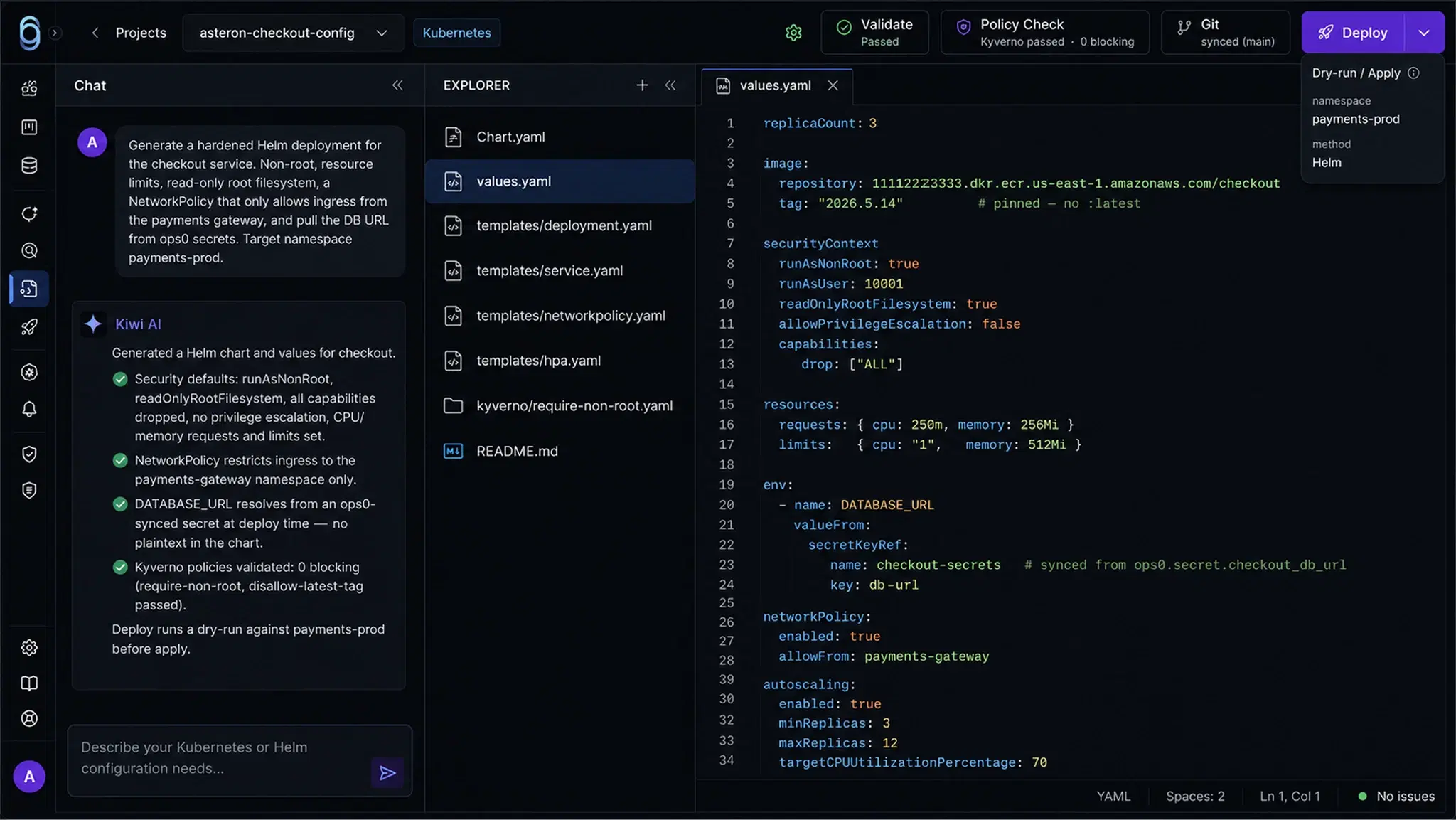
Ansible and Kubernetes config in one surface
Rego for Ansible and Kyverno for K8s policy injection
Dry-run, approval, and execute modes built in
Helm, kubectl, and kubeconfig flows without side scripts
ops0 config run
DRY RUN READY
Request

Generate an Ansible playbook to harden Ubuntu web servers and apply a matching Kyverno policy to the production ingress namespace.

Target
Servers + K8s
Policy
Injected
Mode
Dry run
Approval
Required
Generated output
site.ymlPackage hardening and service configuration
group_vars/prod.ymlEnvironment-specific variables
kyverno-policy.yamlIngress restrictions and namespace guardrails
→ Review and executeDry-run output available first
From Intent

Generate configuration the same way you ask for it.

ops0 brings conversational generation to Ansible and Kubernetes configuration, so teams stop treating operational config as a second-class workflow outside the platform.

  • Supports server and server-group targets for Ansible
  • Supports Kubernetes cluster targets for manifests and charts
  • Extended AI reasoning helps produce useful first drafts instead of toy snippets
Policy-Aware

Rules are part of generation, not a cleanup step.

Ansible generation pulls in Rego policies. Kubernetes generation pulls in Kyverno policies. The output is shaped with the same governance context that will later be used to review execution.

  • Policy injection happens before the draft is generated
  • Useful for hardening, access, and environment-specific standards
  • Keeps configuration generation aligned with the same operating model as IaC
Execution

Dry-run first. Approval before execute.

Generated configuration is not treated as magic. Ansible and Kubernetes execution supports dry-run modes, gated execution, and human approval before changes land in live systems.

  • Dry-run-only, dry-run-and-execute, and execute-only modes
  • Useful for high-trust automation without blind execution
  • Fits into the same workflow engine as infrastructure deploys
Kubernetes

Operate manifests and Helm without leaving the platform.

Kubernetes configuration supports kubectl apply, full Helm chart deployment, and cluster authentication across EKS, GKE, AKS, and self-managed environments.

  • EKS, GKE, AKS, and kubeconfig-backed clusters supported
  • Helm workflows are first-class instead of sidecar scripts
  • Useful for app delivery, cluster add-ons, and policy-managed changes
Secrets

Execution safety is built into the path.

Configuration execution includes encrypted secret handling, controlled file permissions, retries, and validation, so teams do not have to stitch together brittle wrappers around their automation.

  • AES-256-GCM handling for sensitive execution materials
  • Retries, timeouts, and error policy are configurable
  • Safer than passing secrets and scripts around by hand
Unified Surface

Terraform and configuration no longer live in different worlds.

ops0 brings provisioning and configuration into one platform, which means policy, execution control, and workflow logic do not split the moment infrastructure becomes software.

  • Useful for teams managing both provisioning and system configuration
  • Infrastructure and configuration steps can live in one workflow graph
  • Same UI, same permissions model, same governance posture
Next Move

Configuration steps
fit inside the workflow graph.

Once configuration is governed, the next surface is workflows: approvals, deploy steps, branching, retries, and notifications across infrastructure actions.

Generate configuration you can actually run.

From code to cloud in
minutes, not days.

All services are online
ops0 binary code decoration