Audit proof without handing over the platform.
ops0 records deployments, policy checks, compliance scans, and report posture as infrastructure changes, so infrastructure audit evidence already exists when auditors ask for it, ready to share as a report or a signed audit pack.
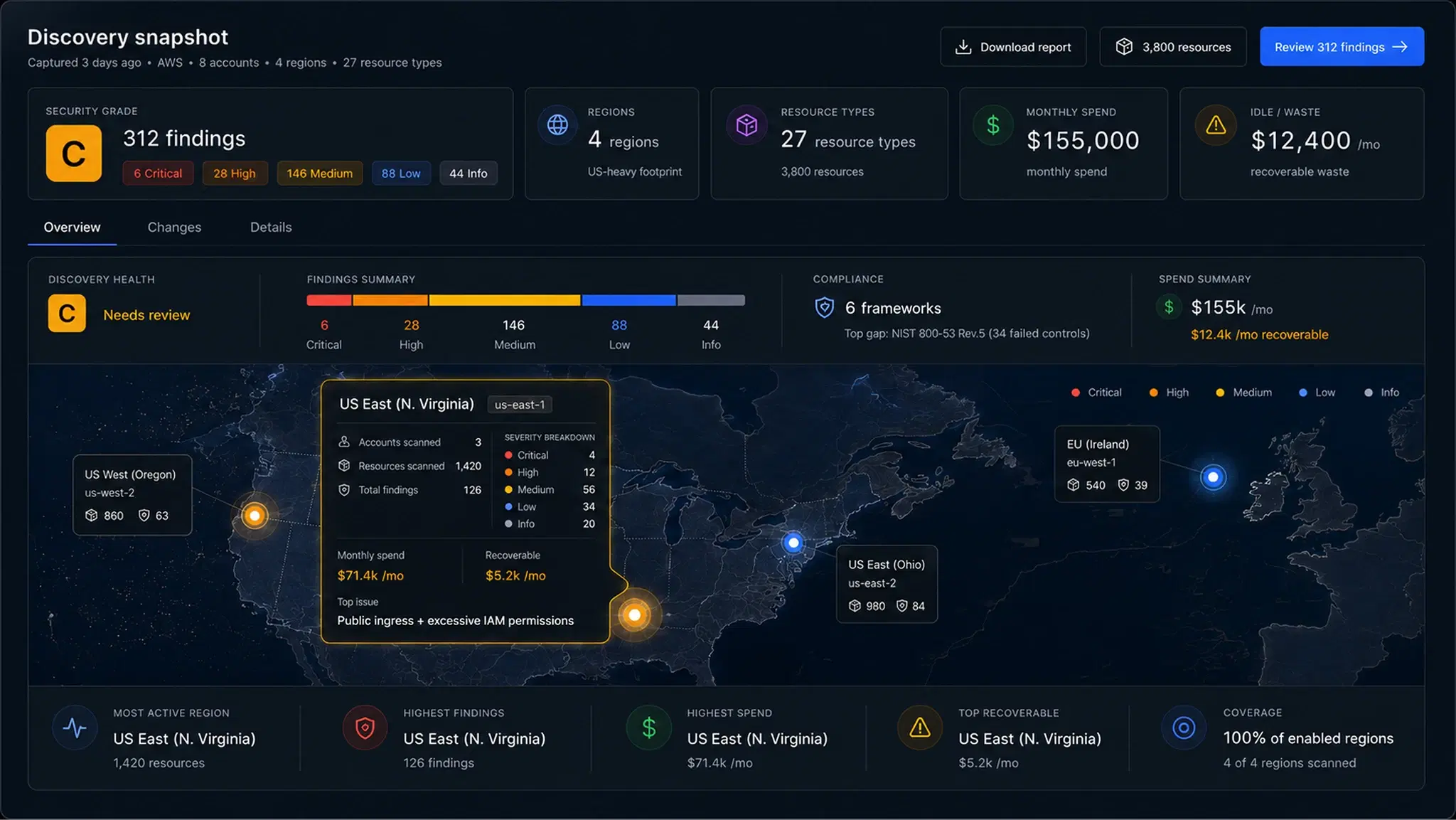
ops0 brings your clouds, runtime, infrastructure code, and workflows into one operating context. Infrastructure audit and reporting turns deployment history, policy checks, and compliance scans into snapshot-based reports, executive dashboards, and control evidence that can be shared with auditors without opening the platform.
What a cloud infrastructure audit covers
A cloud infrastructure audit is a structured review of what is running in your cloud accounts, who can change it, how it is exposed, and whether there is evidence to prove each answer. It covers seven areas, and for each one an auditor asks the same two things: is the control in place, and can you show it?
Inventory and ownership
An audit can only cover what is on the list, so the first question is whether the list is complete and every item has an owner.
4 checksIdentity and access
Most cloud incidents start with a credential, so auditors spend the most time on who can do what and how that access is protected.
5 checksNetwork exposure
Anything reachable from the internet should be reachable on purpose, and the audit asks for the list and the reason behind each entry.
4 checksData protection
Encryption and key handling are easy to check and easy to get wrong, which is why they appear in every framework.
4 checksLogging and monitoring
Without a complete audit trail none of the other answers can be verified, so the trail itself is audited.
4 checksChange management
Auditors sample changes and ask for the request, the review, and the approval behind each one.
4 checksResilience and recovery
A backup that has never been restored is an assumption, and the audit asks for the restore test, not the backup setting.
4 checksThe full checklist
All 29 checks, the evidence to collect for each, and read-only commands that gather it.
An audit request usually means a week of screenshots. Here the proof is already collected.
The auditor asks.
Show every production change last quarter, who approved it, and what it passed.
Show every production change last quarter and who approved it
Evidence, controls, and a report ready to send.
Audit evidence is created while infrastructure changes.
Built for the auditor, not just the engineer.
A branded PDF export, frozen at share time, so what an auditor reviews never shifts mid-review.
The platform producing this evidence carries its own attestation.
In practice
Review infrastructure evidence with a repeatable checklist.
For each check, capture the environment, resource, evidence timestamp, owner, and follow-up. The examples below show how to turn a finding into a reviewable action; they are illustrative, not results from a customer audit.
| Check | Evidence to collect | Example finding | Next action |
|---|---|---|---|
| Resource ownership | Inventory with account, region, and owner tags | A resource has no owner tag | Assign an accountable team and review why it exists |
| IAM permissions | Policy JSON and relevant access context | A policy allows broad actions on every resource | Review required actions and resource scope with the owner |
| Public exposure | Network rules and storage access configuration | An endpoint is reachable beyond its intended audience | Confirm the business requirement and review a scoped change |
| Change approval | Change reference, reviewer, plan, and policy result | A production change has no linked approval | Reconcile the record and address the workflow gap |
| Remediation verification | Updated configuration and a fresh scan or check | A finding was marked complete without verification | Recheck the same resource and retain the new evidence |
For period-based evidence, choose the audit period and cloud scope, reconcile the recorded population, and review exceptions before generating a signed pack. Coverage depends on records available in ops0. A signature supports integrity checks; it does not certify compliance.
29 checks across 7 areas, each with the evidence to collect and what a pass looks like, plus empty scope, finding, owner, and action columns for your team to fill in. It is a worksheet template, not an ops0 audit report.
Common questions
Send proof
without recreating it.
The audit becomes a review of evidence, not a search for it, because every change recorded its own evidence along the way.